Working on the vision

There is a distinct advantage to going somewhere new, seeing things for the first time. There’s an initial overwhelming stage of trying to get the sense of the place and getting the pictures that capture where you are. After a while though, you start to look closer.

One of the benefits of this experience in Florence, Italy, has been giving me a chance to shake off the routine and to look at what’s around me. Not just to look, but to see and along the way to think about what I’m seeing. I’ve been thinking about the work of other photographers and their use of light/composition/moment. The perfect moment doesn’t always happen just as you arrive with a camera. Sometimes it’s recognizing the scene and what makes it a picture. Or just seeing a pattern of light and waiting. Someone is going to walk in or out of that light. What do you want to say? Is that person coming out of the darkness? Or heading into it? Patience….

streetandsun

Continue reading

Persistence (noun)

Firm or obstinate continuance in a course of action in spite of difficulty or opposition.

At least it doesn’t say continuous.

It’s been a while. A stressful semester overall wound up with a frantic push to finish grades while preparing to lead an overseas study program for the School of Journalism. I’m afraid that while the vision didn’t waver, putting that vision into words took a back seat.

It’s difficult to pick up in the same vein. I’ve been trying to figure out what the next topic should be, and there are so many. Another couple of photojournalists killed. New views of World War I uncovered. Agencies that have represented the elite of photojournalism redefining themselves and experimenting with different ways to raise capital.

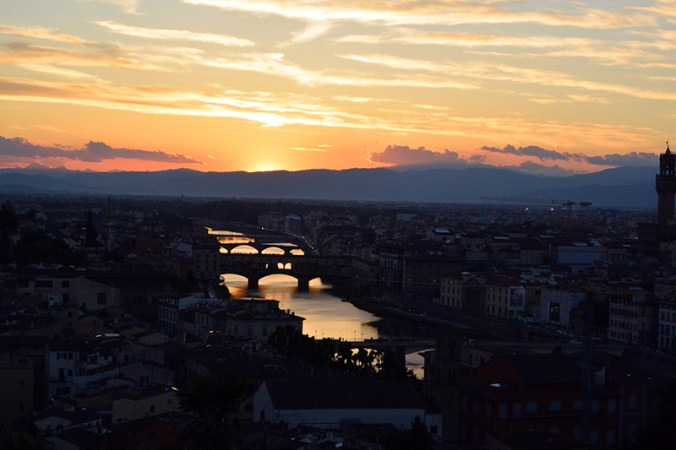
But then it became apparent that the main thing was to get rolling again. It also became apparent that not everything has to be a “deep thought” about photography. Sometimes sharing what others have written, or just putting something of my own out there reflects the persistent vision. So, in spite of difficulty I obstinately return to the keyboard. There is more to write about. In the meantime, a view from Florence, Italy.

Ciao.

sunset

Not stealing this picture

Getty Images is making news (and shaking some feathers) with its announcement that 35 million photographs from it files can now be freely used online (under certain conditions).

Embed from Getty Images

It took a while to figure out the mechanics. The reporting doesn’t give details. I finally found a path to the instructions deep in Terms of Use document on the Getty site.  Continue reading

Pictures of the Year: Finding Stories Everywhere – Lens

Pictures of the Year International wrapped up judging for the 71st annual competition this week. Five different panels of judges selected winners in individual picture and Photographer of the Year categories over three weeks of judging at the University of Missouri. There’s some stunning work that exemplifies the best of photojournalism over the past year.

Today’s New York Times Lens blog has a rundown of the winners along with some inspiring quotes. Newspaper Photographer of the Year Barbara Davidson: “I’m a firm believer that there are good stories to be told anywhere, and foreign is relative to where you are.” Davidson also gives credit to the editing side of photojournalism: “Smart editing is usually what makes a piece stand out.”

Read more about the winners on the Lens blog, and check out the winning picture galleries on the POYi site.

Persistence and evolution

The “future of photojournalism” has been a topic of debate/lament for the past few years as the media landscape changes. (Actually, it’s been a topic for decades as the media world has changed, but that’s another story.)

A common refrain is that the future is bleak: publication outlets are diminishing, the ones that remain are cutting staff and devoting less room for photojournalism, everyone has a smartphone and an instagram feed. You can excuse those who are passionate about photojournalism for feeling like the walls are crumbling, the rug has been pulled out, (insert your own metaphor here). Everyone once in a while though a voice pops up to say,”Wait a minute. Maybe we’re looking at this the wrong way.” Continue reading

Some things aren’t so persistent

U.S. News has decided to delete part of its digital archive. According to Jim Romenesko, the publication switched to a new content management system (the software that tracks content and helps to compile it for various forms of presentation). The new system “couldn’t effectively keep archived web content published prior to 2007 on our site.” So the publication decided to dump it from its own archive, noting the content resides in other databases like Lexis and EBSCO. A form of the content is also in the printed magazine, preserved in bound volumes.

From a management, “how do we make efficient use of our resources” standpoint I can see the rationale behind this decision. From a history/research perspective, it’s short-sighted. From a visual perspective, it’s a right pain. Continue reading

The case of the missing camcorder

A photographer lost his job last week. Associated Press cut its ties with Narciso Contreras because the photographer digitally altered a news picture made in Syria. Specifically, Contreras replicated the ground around the camcorder to replace it in the lower left corner of the frame. It wasn’t the focus of action. It was barely in the frame. But, as he told AP, he thought it would be distracting so he removed it.

He shouldn’t have.

Comments in the online world are somewhat mixed about the episode. There are those who believe that if the change doesn’t affect the meaning of the picture then it’s fine. There are those who believe since other parts of the image are manipulated it’s arbitrary to say some changes are OK and others will get you fired. There are those who say changing pictures should get you fired, and some who would extend that to any change.

Altering pictures is as old as photography itself. Some changes are made to create something the camera didn’t see. Other changes are made so we can see what the photographer saw instead of the what the camera saw. Let me explain. In the days of film, and now with digital sensors, as good as the medium is it can’t replicate the range of human vision. Tri-X black and white film wasn’t particularly sensitive to the blue of the sky. A photographer might see a deep blue sky with a few white clouds, but the film couldn’t pick up that contrast with the proper exposure for the rest of the frame. Photographers could give the sky area of a photograph additional exposure so the clouds would be separate from the blue sky and the scene could better represent what the photographer saw. In photojournalism, that kind of alteration to adjust for technical limitations of the medium been considered ethical.

What has not been considered ethical in photojournalism is to add and/or remove things that alter the scene the photographer saw. In this case, removing a camcorder. It doesn’t represent the reality of the moment. Some people see that as an arbitrary judgment. The photograph still shows the fighter with his weapon. Does the missing camcorder really change that? Well, we don’t know do we? Whose camcorder was it and why was it there? More importantly, if that was changed what else was changed?

We’re up against an increasingly cynical world of viewers, I believe, who are more vocal about questioning the photographs they see. In their world, even though they weren’t at the scene the photograph’s truthfulness should be questioned. That’s why for news photographers it’s important to maintain the position that the photograph shows the viewer what was actually there. Yes, kick yourself for not noticing that extraneous thing in the frame and adjusting the camera angle so it doesn’t add a distracting element. Learn from it and grow in your awareness like photographers for decades have done. Don’t change the picture after the fact if you want to maintain your position as a reputable photojournalist.

Unfortunately (as least from my perspective), Narciso Contreras will probably not be the last photographer to manipulate the content of a news photograph. There will be other cases, and debates will continue over what’s acceptable and why. If the ultimate question is the preservation of credibility in news photographs, the standards have to be high. Otherwise, we’re back to artists illustrating what they think the scene looked like.

I could probably have included the before and after photographs as an example of fair use and criticism, but I’ll link to them and the AP announcement of the incident instead. You can see the photographs and read the response on the AP website.

Update: The PDN Pulse blog today has a conversation with the photographer about the incident.

Danny Lyon’s persistence

Danny Lyon jumped into photojournalism in the civil rights era. Not happy with the view he saw in mass-market publications like LIFE, Mr. Lyon set out to produce the unseen parts of the story. He’s receiving attention this month after an appearance at a National Geographic seminar where he talked about his work and career. He’s apparently got some interesting ideas on how he’d edit the magazine.

He’s also the subject of the Lens blog at the New York Times. The main idea is Lyon’s agitation for people to pursue justice and freedom. It’s something he’s been consistent (persistent) about in his career.

Mr. Lyon can be an abrasive character. He says what he thinks. The audience or venue doesn’t really change that. If everyone were like that, we’d have a tough time getting along in the world. But if no one is willing to take that stand, it’s too easy for problems to get papered over. No one wants to shake up or offend anyone, and it becomes too easy for those who should be called out to misdirect the focus.

There are photographers who have set out to shake things up a bit. Don McCullin, W. Eugene Smith, Gordon Parks all professed to a philosophy of using their cameras as “weapons” to try to shine light on problems and urge people to become involved in changing the situation. We benefit when photographers shine lights in dark corners. I applaud the ones who have the courage to do so.

Read about Danny Lyon and his work on the NY Times Lens blog.

Will visions persist?

I recently saw the 2013 version of The Secret Life of Walter Mitty. The story in general is about a guy who daydreams his way through different adventures, in contrast to his non-adventurous life. (I can relate. My mind does tend to wander.) There was an earlier film starring Danny Kaye that I haven’t seen yet. (It’s recorded, but I haven’t seen it yet.)

In this version, our hero works in the photographic archives of LIFE magazine. The magazine is facing its final issue, having been bought by another company with designs on taking the publication online. Walter has been sent a roll of film by one of the publication’s famous conflict photographers. A search for a specific negative provides the basis for Walter to break out of his daydreams and actually pursue an adventure or two. The film includes many scenes supposedly of the LIFE offices, including one where we see Walter running past enlarged pictures of notable LIFE covers, until he runs past one where he’s been substituted as the astronaut.

walter-mitty-publicity-still-photo
Still photograph from The Secret Life of Walter Mitty

This isn’t meant to be a film criticism. I enjoyed the film, but there were parts that more than strained believability. However, it was fun to have my own daydream about Walter’s job. Working in a photographic archive like LIFE’s would be amazing. Keeping track of and preserving the visual record amassed by those photographers would be an awesome responsibility. I’m just a few decades too late to find myself doing much in a working archive of negatives, slides and prints.

Today’s agencies, publications and archives are likely to work with digital materials rather than physical ones, but the purpose of cataloging and preserving those files is just as necessary. There are new dangers though. Prints and negatives certainly degrade if not properly cared for, but they often can still be viewed and their message received. Digital files can be corrupted by media failures, transient voltage anomalies, magnetism, etc., and the disruption can render the entire file unreadable. As software and hardware change, file formats and media can become obsolete and unreadable. Those images, unlike the physical ones, are likely lost.

Preserving the digital files is important, but it takes effort to monitor file status and to update formats and media from time to time. Unfortunately, in many publications the people who would most likely be devoted to that are being cut. Librarian and archivist positions are dwindling within individual publications. At the same time, photographer positions are disappearing too, leaving more photographers to work independently. Digital file management is more involved than putting prints and negatives in a box with a date and assignment title. Photographers, and the people who do research with photographs, need more training to make sure their files will be accessible in both the near and the distant futures. Without it, visions of who we are and what we’ve done will disappear.