The rules on the ground

There were differing interpretations of the rules that govern journalism in this country on the University of Missouri campus today. Journalists, practicing their trade in a public space, were hindered as participants in an event they were attempting to cover decided they would make the rules.

A little background…..

It’s been an interesting semester at the University. A number of issues related to graduate student support and religious and racial intolerance have led to student demonstrations and expectations of responses from the university’s top officials. The responses have been found to be lacking in details or evidence of understanding of the students’ perspectives on the issues. Admittedly, that description is a bit oversimplified. The end result however is that concern by students, faculty and staff over a lack of leadership resulted in the resignation of the president of the University of Missouri system. Later in the day the Columbia campus chancellor also announced he would leave that post by the end of the year.

As part of the student response, African-American student leaders had erected a tent city in an open space on campus. When the system president’s resignation was announced, supporters who had gathered there celebrated. Journalists were there to document the reactions of the participants. And that’s when the rules became an issue.

Student leaders and their supporters wanted journalists to stay at a distance from the tents to allow a space for privacy. Some decided that journalists, including photographers, were too close and they would be moved back by participants linking arms and moving forward as a human wall, pushing anyone in their path ahead of them as they announced “We’re just walking. We have a right to walk.” As a photographer, also a student, attempted to make photographs the participants pushed into him and raised their voices to say, among other things, that he didn’t have the right to take their pictures. They raised their hands to attempt to block photographers’ views of the space behind their wall.

Except this is a public space. The University of Missouri is a public institution. The quadrangle in question is an open, publicly-accessible space. Photography in public is legal and within the rights of anyone to do. Making up the rules because you don’t want someone to do something within their rights isn’t acceptable.

Compounding the issue, a university staff member inserted herself between the participants and the photographer, further claiming that the photographer was not allowed there. It’s ironic that the staff member who works within the student life division of the university proactively attempted to deny a student his rights. A faculty member of another department on campus (not the School of Journalism) also told a student with a camera he had to leave, that media had to back up and respect the assembled students, ignoring that some of the people she was attempting to get removed were themselves students. She also summoned “muscle” to help remove another reporter from inside the wall. (There’s video: https://www.youtube.com/watch?v=xRlRAyulN4o. The muscle comment si toward the end, but the staff person inserts herself at about 2:00 telling the photographer to back off from her personal space after she got in the photographer’s face.)

What some of these participants failed to understand is that the student photographers have actually been at the site, talking with the student leaders and covering the story longer than some of the participants themselves have been involved. They’ve built relationships with some of the leaders. They are respectful if a person, when asked, declines to talk with them or just asks for a bit of privacy before letting someone in.

When the rules on the ground diverge from the rules on paper, journalists have to assert their rights to work in public spaces while exhibiting concern and empathy for their subjects. They are also taught to recognize when not to escalate the situation, giving those who would bend or outright make up the rules room to do just that. The photographers tried to explain. The participants didn’t want to hear.

In the grand scheme, the bigger story is the actions of a lot of people to say the conditions and leadership aren’t acceptable and the response that occurred from peaceful efforts. These attempts to exclude people from a space where they have rightful access is a small chapter of the story, but it is, nonetheless part of the story. Unfortunately, it’s also an old one as people through history have attempted to prevent photojournalists from witnessing history and sharing the view with others. But as much as leaders want to say “that’s not for your story” or “someone else already did it” they have to accept that their ability to enforce that position may be limited by what the rules allow.

The faculty and staff members who were identified as interfering with photographers’ ability to document (and calling for others to assist in forcible removal) have been identified and called out for their actions. However, they too are not the biggest story of the day and shouldn’t become so either. They should be made aware that what they did runs counter to the rules. They should apologize. They should be held accountable. They should not be threatened or be subject to the internet equivalent of “some muscle.” We need to be better than that.

The rules on the ground shouldn’t be what a group thinks they should be, and while passionate students may not fully understand rules of access and rights for the public and  journalists, the faculty and staff members shouldn’t be making them up either. Other than educating the public, I don’t know what the answer is other than for photographers and other journalists to continue to firmly but politely assert their rights to work in public spaces. The problem is, education for those who don’t want it isn’t going to be much of an answer is it?

Edgar Allen Poe on photography

If we examine a work of ordinary art, by means of a powerful microscope, all traces of resemblance to nature will disappear—but the closest scrutiny of the photogenic drawing discloses only a more absolute truth, a more perfect identity of aspect with the thing represented. – Edgar Allen Poe, 1840

Long before Susan Sontag wrote On Photography, others put pen to their thoughts on this medium of photography. Edgar Allen Poe was a subject of a photographer’s camera, but he also apparently was a fan of the medium. The Daguerreian Society recently posted a column Poe wrote for Alexander’s Weekly Messenger in 1840, just about a year after the Daguerreotype was officially introduced to the world.

Daguerreotype of Edgar Allan Poe, late May – early June 1849.

Poe gives a simplified explanation of the process of preparing, exposing and developing a Daguerreotype plate, but he also conveys what he sees as the significance of the invention. The quote above communicates his perception that the photograph preserves its ability to present the nature that is recorded even at close inspection. Poe also recognized that at that early stage in the development of photography the impact it might have couldn’t be foretold. While he saw use for making accurate photographs of the moon, how could he conceive that 130 years later humans would be using cameras on the moon?

I like Poe. I like that he liked photography. And I like that he reminds us that as fantastic as we may think something is, we probably haven’t seen anything yet.

* The daguerreotype of Poe is of unknown origin and is in the public domain in the US. This version comes from the Getty Museum’s Open Content Program.

On bearing witness, and being human

I read a variety of blogs. Well, read may be a strong word, but I follow the feeds and read the articles that look interesting. Some of the blogs are like this one, other people writing about their thoughts on a topic and what others are doing. Other blogs come from the people doing the work. They give us a chance to “see” what’s going through their minds as they encounter some situation.

Agence France Press’s Correspondent blog is of the second category. In “A long walk to freedom,” television reporter Helen Percival recounts her experience covering  the wave of migrants in Hungary on their way from Syria, Iraq and Afghanistan to the hope of something better.

The relationship of photographer to subject is a topic often talked about in photojournalism, and definitely in photojournalism education. That topic alone makes this post worth reading. In her words, Percival talks about the line between being a journalist and being a human, “engaging with what you see on a human level” as she puts it. She writes of being hesitant, aware of their condition and considering how she might feel if the roles were reversed. But she also writes of being there for a purpose and how the subjects of her coverage seem to understand that as they “withstood the cameras and photographs with a dignified grace I became familiar with over the coming week.”

Photographers are criticized sometimes for being unfeeling and exploiting the tragedies of others for their own gain. The criticism often comes from people with limited knowledge of the circumstances of the photograph. Percival reminds us that good photographers are aware of the people in front of the lens, but they’re also aware of the people farther back… those of us who couldn’t see what has been unfolding if it weren’t for the photographs and video. The subjects sometimes are aware of that too. Percival’s were, and others have been. Flip Schulke, covering the first attempted march to Selma, tried to intervene to help people who were being clubbed by police. A human response, but King later reminded him that his job was to photograph because without the pictures no one else would see what unfolded.

Percival’s post is accompanied by the photographs of other AFP photographers. The images and the words add perspective to the stories in the news.

The meaning of altered

Altering, changing, manipulating…. all words that have a negative connotation in photojournalism/documentary photography. Images made in this genre are supposed to present a scene as it appeared with no direct intervention on the part of the photographer. It violates ethical standards to change a scene and then pass it off as the reality the photographer saw. At least it does in US media systems in our current times.

The topic comes up in relation to a current exhibit at the Bronx Documentary Center in New York. Altered Images” presents “150 years of posed and manipulated documentary photography.” The exhibit “explores disputed images in photojournalism and documentary photography–photos that have been faked, posed, or manipulated.” The description goes on to say photographers and editors have misled the public while others have made mistakes in judgment. It also notes that government regimes have used photographs as propaganda. Examples of all these are presented in the exhibit.

The question, though, is what constitutes “altered?” Or maybe it’s what defines documentary photography?

Some of the examples in the exhibition are clearly manipulated outside the ethical limitations of photojournalism/documentary photography of the time. Recent examples of PhotoShop cloning of smoke after the shelling of Beirut, removing a video camera from a photograph of a Syrian opposition fighter or combining frames of a soldier and civilians in Iraq are well-known examples of current violations, and photographers faced consequences for their actions.

Less well known are some mid-20th century photographs by W. Eugene Smith, who it seems combined negatives or employed darkroom and post-printing techniques to change the direction of a subject’s gaze in an image. Again, these would not have been approved under ethical standards of photojournalism and documentary photography at the time. They clearly represent altering an image. Other photographs in the exhibit have been topics of questions for years, such as Robert Capa’s “Death of a Spanish Loyalist” photograph.

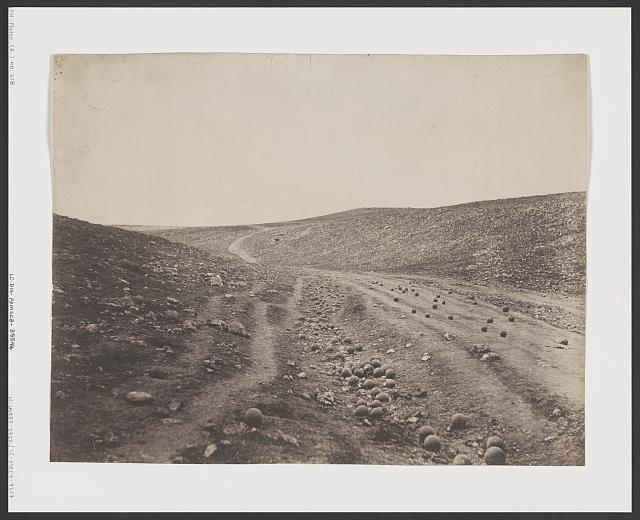
But what about photographs made in the first half century of photography, for instance, when the concepts of “documentary” photography meant something different? Were those photographers trying to create an untouched scene just the way they found it, or were they trying to communicate an idea? The Altered Images exhibit includes Roger Fenton’s photographs of a Crimean War battlefield. In one image cannonball line a ditch on the side of the road, while in another the cannonballs are strewn across the road. Evidence suggests Fenton moved the cannonballs from the ditch onto the road to make the second photograph. So yes, in that sense the scene is altered/manipulated, but was that the standard Fenton would be held to?

35546r

Roger Fenton Crimean War photograph from Library of Congress


Additional photographs of the American Civil War show that bodies were moved from one location to another and, in some cases, models who were very much alive were used to simulate corpses in an image. Clearly the scenes have been set up, but what do we make of that?

Historians consider the context in which a photograph was made. Not just the conditions of making the photograph but also the environment and culture of photography at the time as well as the intent of the photographer. Can we call these “disputed” images, or do we call them examples of different stages of photojournalism and how the practice has evolved. I’m not taking issue with the Bronx Documentary Center or the idea of the exhibit. It’s clear in some cases that photographers, editors and/or technicians overstepped the bounds, but it’s also necessary to consider intent and standards when the image was made and distributed to determine what that alteration means.

Eadweard Muybridge film in motion

Eadweard Muybridge was a photographer in the late 1800s. His lasting contribution to the photographic world was in motion studies. Muybridge was able to use multiple cameras fired in sequence to create a set of still photographs. The photographs stopped motion, and when the sequence of images was put together the motion was revealed. Things that the eye couldn’t isolate in motion could be seen clearly when frozen. It also was the forerunner of motion pictures.

Muybridge was also a somewhat fiery character who, among other things, was charged with the murder of his wife’s lover. (He was acquitted on the grounds of justifiable homicide.)

Motion 58 is distributing a film centered on Muybridge. Billed as a “psychological drama,” the trailers show a story of a man obsessed with his work and also with his intimate relationships. Some previous attempts to explore a photographer’s world/mind have really been more drama with a known photographer as character. I would like to see what Motion 58 has done with Muybridge. So far it appears to have had limited showings. I’ll have to keep my fingers crossed it comes closer, or find a way to do some traveling.

You can find out more about the film and watch a trailer at the Motion 58 website. There are also a couple of alternate trailers (shorter and longer) on Vimeo.

The_Horse_in_Motion

Try, try (try) again

Another hiatus. As so many academic-types know, there are lots of demands on one’s time. If you have tried to follow this site regularly, you know those demands overtake sharing my perspectives on the photography world.

So… as I sit on the brink of a new academic year we’ll take another stab at adding to the conversation about photography/photojournalism on a more regular basis. Here’s hoping persistence pays off.

Out… In… Out… Out… Out…

It’s contest season in the photojournalism world, and anyone familiar with Pictures of the Year International judging will get the title of this post. As the judges register their votes during the various rounds and categories of judging a voice calls out the result: out, out, out, out, in. For many years that was a student voice (mine included once), but now it’s mechanical, which seems almost more appropriate given the mechanical process the judges have to go through to evaluate the photographs. Some categories start with more than 1,000 entries that the judges have to whittle down to the top three plus, perhaps, a few awards of excellence.

I’m not using the term mechanical as a criticism. It’s just referring to the repetition and the quick decisions the judges have to go through. Having observed some judging sessions, I know the judges actively look at each picture before registering their votes. When the selections are narrowed down to the final choices, debate over the merits of an individual photograph, what it shows and how it reflects the ideals of the competition often are deep and thoughtful, even if the judges disagree. When it’s all said and done though, the judges of POY (and, I suspect, World Press Photo, the Pulitzers, Best of Photojournalism and other contests) come to some agreement on their selections of the best examples of photojournalism from the previous year.

Differing views of photographs are not unique. The one universal truth about photographs is that there is no universal truth. There is, and has been, a perception that photographs are mechanical recordings of how things actually appeared at a point in time. In sense that is true, but in actuality, how photographs are seen and interpreted by a viewer is influenced by many things: the content of the picture, the goals of the photographer in creating the image and information that explains and provides context to the picture. Add to that the individual perspectives of each viewer and it’s no surprise that one person’s beautiful sunset is another person’s evidence of heightened air pollution. Judges disagree.  A different group of judges would bring different points of disagreement. People disagree with the judges and with each other. A former judge, Brad Mangin, wrote about the differing perspectives judges bring and how our different perspectives are formed.

What can we take from the differing views of the award-winning (and not-so-award-winning) photographs? A reminder to look at things from a different perspective from time to time, perhaps. Or opportunities to assess our own perspectives by challenging them with perspectives of others. It’s how we grow, and how our “vision” evolves.

In the meantime, we get to see a lot of great photography. Thanks to the judges of all the competitions for the time and effort they put into the work.

By the way,  you can see the winning photographs of POYi after judging for each category is completed at www.poyi.org.

Commitment to photography ≠ commitment to photographers

With apologies to the Beatles, I heard the news today… and oh boy.

Sports Illustrated has announced it’s laid off its six remaining staff photographers. It would be hard to argue that photography is important to the magazine. Photographs have played a role in the magazine since its inception. Even as the focus of the magazine has shifted, photography has been featured on the cover and inside the magazine’s pages.

Now the publication has joined a line of those who have decided that while photography is desirable, maintaining those who create the photographs is not. In an article on the National Press Photographers Association’s site, SI’s director of photography, Brad Smith, confirms that economic circumstances led to elimination of the staff photographers’ jobs.

What’s interesting is that Smith also says the magazine’s commitment to photography hasn’t changed. SI will still cover games and tournaments, will present portraits of athletes, and so on, it just will be doing it with photographers who are working independently. Photographs, yes. Photographers, not so much.

It was pointed out to me that freelancers are always cheaper. I’m sure they are, at least in the short-term. But it seems to me that if your “commitment to photography is as strong as ever”(as Smith says),  it shouldn’t be a stretch to maintain a commitment to the people who make the photographs.

A new semester, and advice from Hunter S. Thompson

We start a new semester of classes at the university today. I’ve lost track of how many “first days” this makes, but they’re always enjoyable. There’s hope and promise of what’s about to come, even in the midst of winter.

I’m also using it as an occasion to renew attention to this blog. So far there’s been a somewhat consistent pattern of renewed energy, followed by conflicting demands for attention followed by inactivity here. It’s not that the vision is inconsistent. Finding topics to write about however……

In that spirit I’m taking some words from Hunter S. Thompson as inspiration. In an entry on the Petapixel blog today, Michael Zhang presented a letter Thompson wrote to Pop Photo magazine in 1962, responding to an article the magazine had published. In the letter, Thompson talked about feeling at one time after being in New York like one shouldn’t take a picture without the benefit of professional instruction and top-end equipment. The technical details of how photography works overtakes the purpose of photography.

In the letter I read this quote: “When photography gets so technical as to intimidate people, the element of simple enjoyment is bound to suffer.” 

That’s applicable to both teaching and blogging at the beginning of this new semester. One can overthink what students are supposed to get out of the class and overlook the enjoyment of recognizing their growth. One can get so consumed in having profound words to say about a topic and overlook the pleasure of just sharing something interesting.

You can read Thompson’s whole letter on the Petapixel post.

So, with Hunter’s words in mind, we’ll pick up the vision.

Crowing about photography

LIFE magazine, April 26, 1937.

LIFE cover from TIME.com website.

This is sort of an old article (September 10) from the TIME.com website, but it’s still worth noting.

LIFE magazine was a force in photojournalism for much of the 20th century. Launched in 1936, it set new standards for using photographs and created new expectations in the public’s mind for seeing people and events as opposed to reading about them.

The publication was also famous for that red rectangle with the word LIFE in white letters. That logo was featured prominently on the cover of every issue…. apparently except one.

The TIME article on its LIFE Behind the Picture blog notes that the April 26, 1937, issue featured a photograph of a White Leghorn rooster on the cover. The rooster’s comb appeared in the same area that the logo would. The publisher, Henry Luce, didn’t want the logo to cover the rooster’s comb and detract from the photograph, and he didn’t like the comb obscuring the logo. Solution? No logo! The word LIFE does appear in the lower left corner of the cover, but the logo that would be prominent on all the other covers doesn’t appear on this one. On the contents page the photo credit notes “LIFE’s title is not boldly superimposed on this week’s cover because that would have spoiled the composition of this picture.”

In our current publication climate logos regularly interact with cover photography, either over part of the photograph or partially covered by some element of the photograph. There are undoubtedly publications that do have minimal logos, but for the majority of magazines (or newspapers) these days, what would it take for an editor/publisher to say, “This picture is too good. Let’s do something different with the logo.”?

I don’t know, but it would be interesting to find out. In the meantime, check out the LIFE rooster cover. (By the way, the photograph is by Torkel Korling, a photographer with the  Black Star picture agency.)